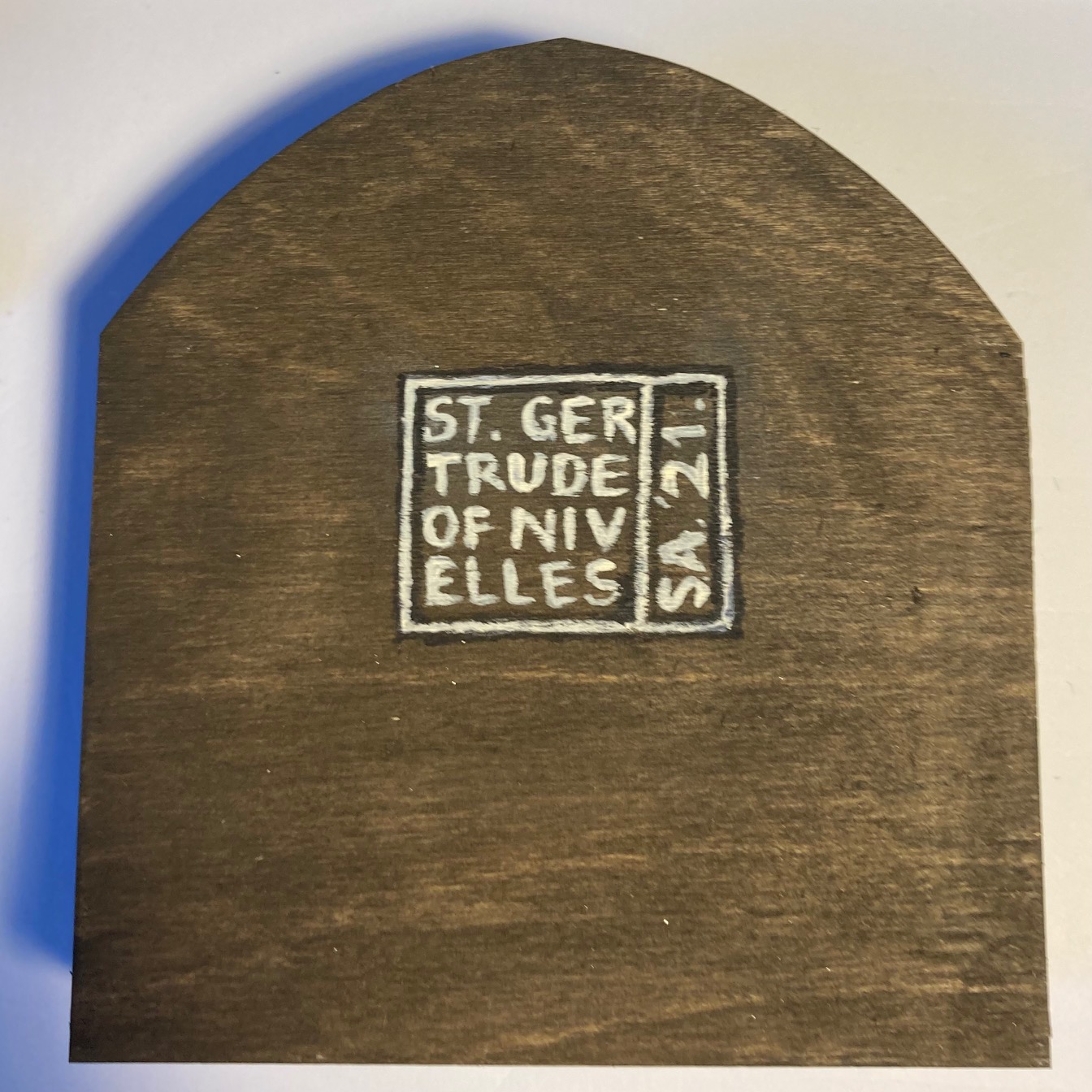
St. Gertrude of Nivelles is the Catholic Patron Saint of gardeners, mental health, mice and cats. She is also associated with saving people from plague, as during the Black Death she was venerated for driving out mice and rats. All of which seems very appropriate during these times!
Gertrude was a 7th century noblewoman whose first notable action was at age 10, when she refused to marry an Austrasian (former kingdom spanning parts of northern france, germany and the lowlands) Prince, stating that she would rather be "married to Christ". Women's feelings were rarely taken in to account, but the marriage did not go ahead as her father died shortly after. To protect Gertrude's virtue and chastity, and (possibly more importantly) prevent her being taken advantage of by suitors only interested in her families wealth and land, Gertrude's mother Itta is said to have shaved the girls head and placed her in a monastery. Gertrude spent the rest of her life fasting, praying and eventually became the Abbess of Nivelles.
She died quite young (by our standards) at 33 years old, with chroniclers crediting her weakened state to excessive fasting and abstinence. She is associated with two 'miracles'. The first was her vision of a burning sphere appearing above the altar she was praying at, and the second was an incident where a ship was attacked by 'a great storm and a sea monster' and was saved when the occupants cried out to Gertrude for help.
Whether you believe in the miracles or not, I think we can all do with a little help with 'Plague' and our collective mental health at the moment, so a beautiful garden with cats seems a perfect place for a tiny altarpiece to St Gertrude.
The cats portrayed in the altarpiece are (L to R) Bella (my house mog), Toby (the PPCG garden cat) and Archie (Toby's on-again-off-again #itscomplicated gentleman friend). Sweet violets are the flower associated with Gertrude, so these have been included in the painted panels (and sown in the beds beneath the Gallery).
Suzi Ashworth
St Gertrude of Nivelles Altarpiece
Mixed media
2021.
Suzi Ashworth is a Folkestone based yarn dyer and illustrator.
To see more of her work follow Folkestone Harbour Yarn on Instagram or Facebook.
Some of you might be aware that I was a panellist for an online Folkestone Book Festival event featuring gardener and author Frances Tophill, talking about rewilding garden spaces.
I appear at about 29 minutes and talk about Payers Pocket garden and how this influences my work with Folkestone Harbour Yarn. Anyone who has seen the event will know that my sound kept dropping out throughout the talk, so here is a transcript of what I actually said!
Talk starts here:
Hi, I'm Suzi Ashworth
from Folkestone Harbour Yarn. I dye yarns and I also look after
Payers Pocket Community Garden.
1st slide,
which is my logo, shows quite a few yarns dyed with some of the
things I have grown in payers pocket. At the top is blue which is
woad, then we go mugwort green, then tansy which is the yellow, and
then we move into the pinks and oranges which are from madder, which
I also grow in the garden.
2ns slide is Payers
Pocket garden. It's a very very small space behind the Quarterhouse
in the heart of the creative quarter. I started working on it 2018,
making a small area for me to grow dye plants there. So I use what I
do (grow) for natural dyeing.
3rd slide. I
grow things like... oh there we go! There is a great big bucket of woad
leaves which are invaluable really, because they are the only native
plant that can produce blue dyes. People have historically imported
indigo from the east, but woad, which you probably know from things
like braveheart and celts smearing themselves with it, produces, after processing, a fantastic blue colour and I can grow it rather
than have to pay for it.
4th slide. I
also use the garden as a workspace during the summer, so there is a
washing line full of various bits and bobs that I have just dyed. I
think there is some nettle on there (the cream/yellow). I do forage
around the garden as well as grow my plants. The bright purply-pink
colour is actually bramble, so blackberries, and it didn't actually
last. I didn't think it would. It actually faded to a sort of
purply-grey but it was quite nice to see that bright colour.
5th slide.
During the last lockdown those of us who use the garden realised that
most people in the area live in flats and they didn't have an outdoor
space, so we formed Payers Pocket Community Garden to make people
aware of the space and encourage them to use it. What we have here is
another organisation in Folkestone called Last Friday's. So they
webcast... they were livestreaming this musician playing in the garden
on the last Friday of the month, so that was really fantastic and
helped people see a little bit about what we were doing. And it was
just a really nice use (of the garden). This lady is actually a
really fantastic professional viol player and recording artist called
Asako Morikawa, who, if you're into your classical music you will have
heard of her. She does live in Folkestone and it was a real honour to
have her there.
6th slide.
The other thing that we do in the garden, or that I have put up in
the last year, is the very grandly named 'Herman Memorial Little Free
Library' and The Pocket Gallery. So this is a miniature library,
because the public library was closed during the last lockdown, and
it has a very, very tiny little art gallery in the top, which I
curate. Every 2-3 weeks a new artist comes along and puts a miniature
piece of artwork in there, which is quite challenging for them
because it is tiny. It's about 18cm wide. It is a 'proper' gallery,
it has lighting and an oiled wooden floor, but the nice thing about
it is that even though it's tiny and its cutesy, it's like a cute
little dolls house, people haven't put cutesy toned-down artwork in
there. This one on the right is by an artist called Charlotte Chapman
and this was her reaction to some of the political discussion and the
headlines during the first pandemic, sorry lockdown, we're still in
the pandemic!
7th slide.
But the most important thing we do is encourage wildlife. So this is
a pallet structure that we built called 'Buggingham Palace'. This is
our giant bee hotel, so there's several layers there and there are
succulents there on top to protect it from the weather. Everything in
the garden, because I have no budget, is reclaimed. It is made from
things that people have chucked away, people have left, so its not
the tidiest looking garden but this is a pile of pallets that we have
transformed and it's done really well, I think. There are quite a few
creatures and creepy crawlies wintering in there now.
8th slide.
One of the other things I have in the garden is a wildlife camera. So
this is one of the young foxes having a good old sniff, seeing what
we are doing. There are a few main things that we have done to
encourage as much wildlife as possible. Firstly I tell anyone using
the garden that it is a chemical free garden, so I discourage the
use of pesticides, chemicals, things like that. It's not really a
manicured, controlled space, we pretty much let things grow where they
want to. Somebody put some tomatoes in the compost and I spread it
out this year, and we ended up with random tomato plants all over the
place. It was quite funny. The centrepiece really is the compost
heap, I won't show you a photo of that because nobody wants to see a
big rotting compost heap, but I'm quite proud of it.
9th slide.
We have a very small water feature but we are going to work on that
very, very soon, putting in a larger pond area and that's about it
really. I cant remember what that (slide) is, oh! That is our one
tiny little water feature, it is essentially a bowl on a stick, and
there is a female blackbird, again having a look at our wildlife
camera.
10th slide.
There we go. This is a beautiful, beautiful rosemary beetle that I
got a great shot of, and one of the local squirrels. I have noticed
(the squirrels) using the space more and more this year, but that
might just be because I'm paying attention! One of the things that I
do in the garden is I use an app on my phone called Seek by iNaturalist. So I wasn't exactly sure about this species of beetle,
but you can scan it, it will feedback the information, It is related
to WWF (world Wildlife Fund) and National Geographic (I'm not paid
for promoting it or anything like that!) but its really useful if you
don't know what the species is. Seek is the name of that, and its
been really helpful. Um, I think I'm repeating myself and I've come
to the end of it so... that's Payers Pocket Garden!